
Short answer: Technical analysis helps crypto traders read price charts for patterns that hint at where a market might head next, using tools like candlestick patterns, the Relative Strength Index (RSI), and MACD to time entries and exits. None of these tools predict the future with certainty — they work in probabilities, not guarantees — but they give beginners a structured framework for decision-making in a market that trades around the clock and reacts to sentiment shifts faster than most traditional assets.
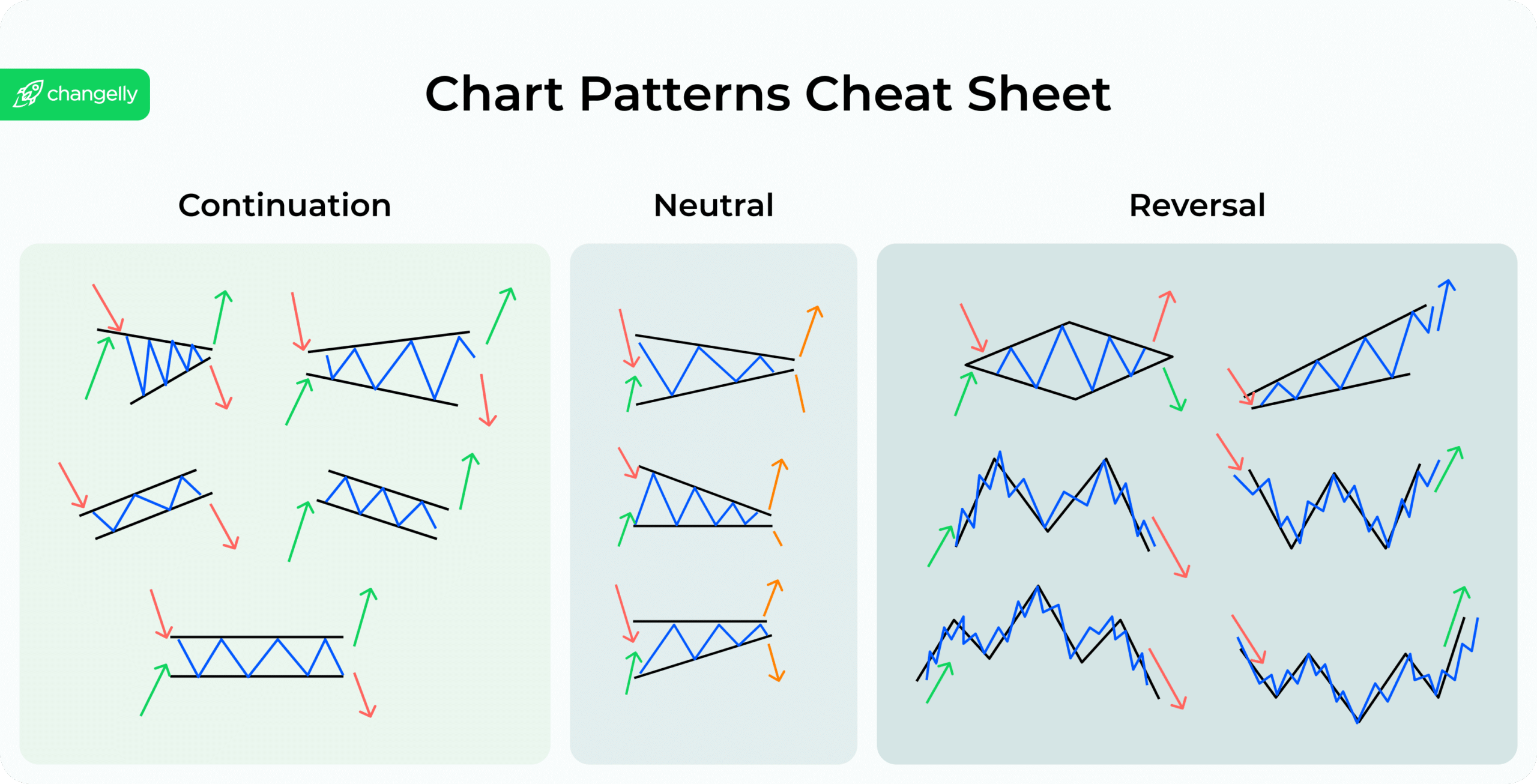
Crypto markets fluctuate wildly, and beginners often feel genuinely overwhelmed trying to make sense of the noise. Technical analysis offers a real lifeline here — it helps spot patterns in price action that can inform when to buy, sell, or simply wait. As crypto adoption continued surging through 2025, with stablecoins and institutional interest both growing, this kind of chart-reading skill became more relevant than ever. Volatility demands tools for making smarter decisions, and that’s exactly what technical analysis provides when used thoughtfully.
Understanding Technical Analysis Basics
Technical analysis studies past price movement to forecast likely future trends, using charts as its main tool. The underlying premise is that prices reflect all publicly known information already, and that history tends to rhyme even if it doesn’t repeat exactly. It’s worth being clear upfront, though: technical analysis isn’t crystal-ball magic. It deals in probabilities, not certainties, and treating any single signal as guaranteed is a common beginner mistake.
Think of technical analysis as something like a roadmap — it shows where the road might bend, without promising exactly what’s around the corner. This matters particularly in crypto, since markets trade continuously with no weekends off, meaning price action never really pauses to digest new information the way traditional markets do overnight or over a weekend.
Candlestick Patterns Explained
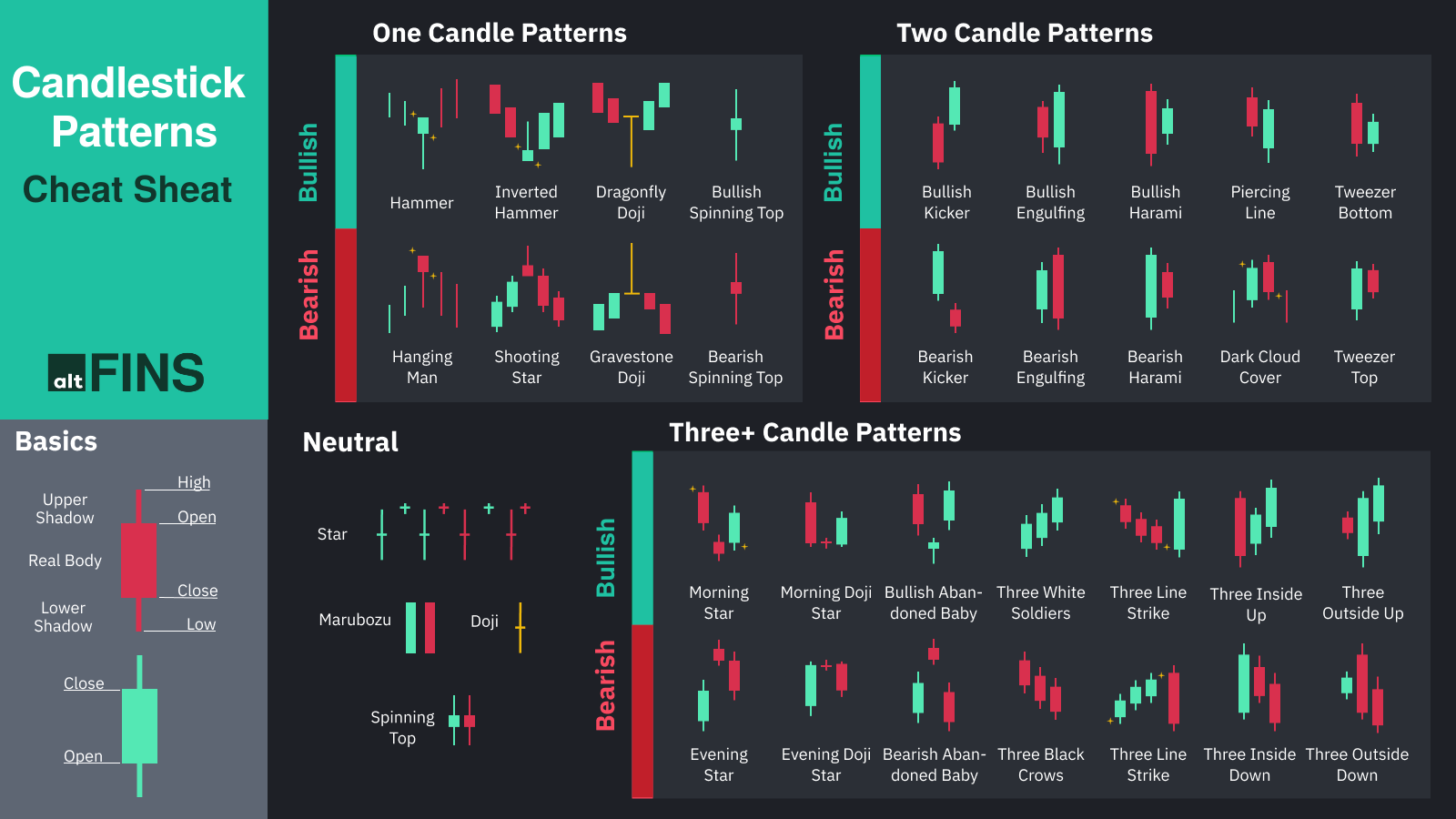
Candlesticks visualize price movement over a given time period. Each candle has a body and wicks — the body shows the opening and closing prices, while the wicks mark the high and low reached during that period. Green candles generally indicate a bullish period, where price closed higher than it opened. Red candles indicate the opposite, a bearish period where price closed lower.
Certain recurring patterns tend to signal potential shifts. A doji, which looks something like a cross, shows genuine indecision in the market — buyers and sellers essentially fought to a standstill. A hammer has a small body with a long lower wick, suggesting a possible reversal upward, something like a hammer striking the bottom of a decline. A shooting star is the mirror image — small body, long upper wick — and tends to signal a potential drop instead.
For example, Chainlink (LINK) formed a hammer pattern in late November 2025, with price bouncing from support around $12.50 and climbing roughly 5% in the following days. Altcoins like LINK often display these patterns quite clearly, since their higher volatility tends to amplify the visual signal compared to steadier assets. Solana showed a similar dynamic mid-2025, when a doji appeared with price hovering around $150 — genuine indecision that preceded a breakout shortly after. Practicing spotting these patterns on free charting tools like TradingView remains one of the best ways to build real intuition over time.
RSI: Gauging Momentum Strength
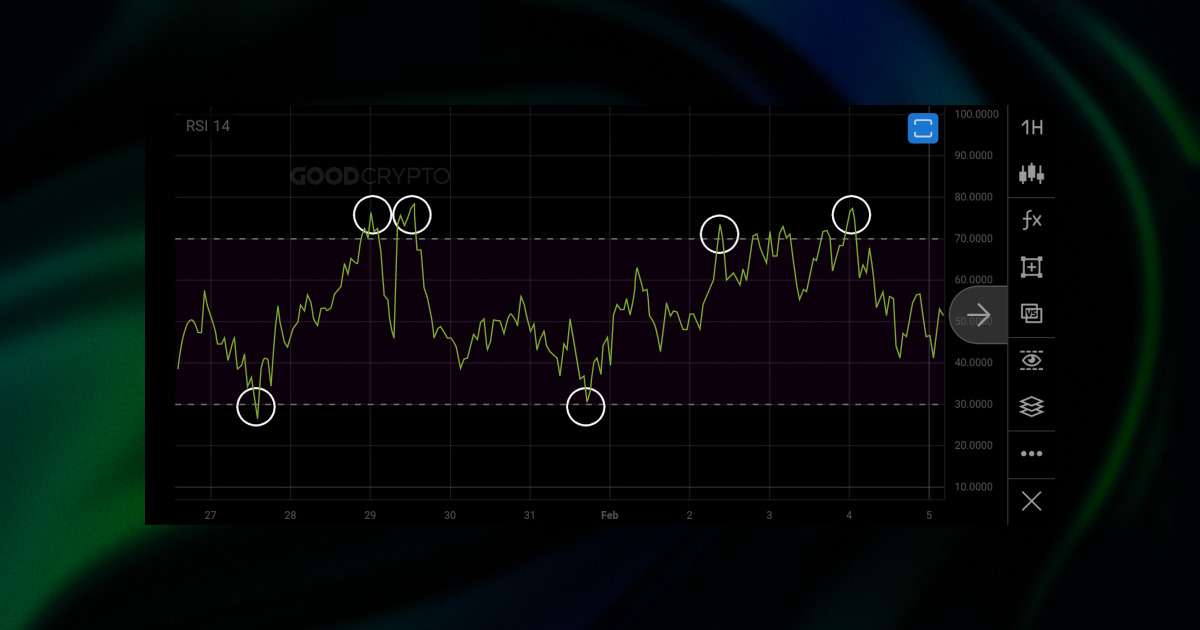
RSI stands for Relative Strength Index, a tool that measures the speed and magnitude of recent price changes on a scale from 0 to 100. A reading above 70 generally suggests an asset is overbought, meaning price may be due for a pullback soon. A reading below 30 suggests the opposite — oversold conditions where a bounce becomes more likely.
A useful analogy: imagine a rubber band stretched too far. Eventually it snaps back toward its resting position. Crypto markets tend to overreact fairly often in both directions, which is exactly why RSI tends to shine as a tool in this specific asset class.
Chainlink offers another useful example here. In October 2025, its RSI hit 75 while price sat around $15 — a correction followed shortly after, pulling price down to roughly $13, which is exactly the kind of setup RSI is designed to flag. Cardano (ADA) showed the opposite pattern in summer 2025, when RSI dipped to 25 and price subsequently rebounded around 10%. Divergence adds another layer of signal too — when price makes a new high but RSI fails to confirm with its own higher high, that combination often reads as a bearish warning sign worth taking seriously.
Combining RSI with other tools rather than relying on it alone tends to produce more reliable results, since RSI in isolation can occasionally mislead, particularly during strong, sustained trends.
MACD: Tracking Trend Changes
MACD stands for Moving Average Convergence Divergence. It uses two lines — the MACD line and a signal line — with a histogram visualizing the gap between them. When the MACD line crosses above the signal line, that’s generally read as a buy signal. When it crosses below, that’s typically read as a sell signal instead.
Think of it something like a traffic light: green for go, red for stop, though obviously with far less certainty than an actual traffic signal provides. In altcoins specifically, MACD tends to be useful for spotting broader momentum shifts before they become obvious on price alone.
Solana offered one clear example in September 2025, when a MACD crossover to the upside occurred around $140, with price subsequently climbing to $160. Chainlink showed the reverse pattern in December 2025 — a bearish crossover warned of a coming drop, and price fell from $13.50 to $12.55 shortly after. Watching for a fading histogram is worth paying attention to as well, since a shrinking gap between the two lines often signals that the current trend is losing steam. Most traders start with MACD’s default settings — 12, 26, and 9 periods — before experimenting with adjustments.
:max_bytes(150000):strip_icc()/dotdash_Final_Moving_Average_Convergence_Divergence_MACD_Aug_2020-02-58bf5e34f0f94730b6e2d56ef9032b6d.jpg)
Current Trends in Crypto Technical Analysis
2025 brought real change to how traders approached the market. Bearish pressure showed up broadly toward year-end, which made diversification an increasingly important part of any sound risk management approach. AI tools increasingly integrated with technical analysis too, with automated systems scanning charts for recognizable patterns faster than any human could manually. Adoption continued growing globally through this period, with markets like India and the U.S. leading much of that expansion.
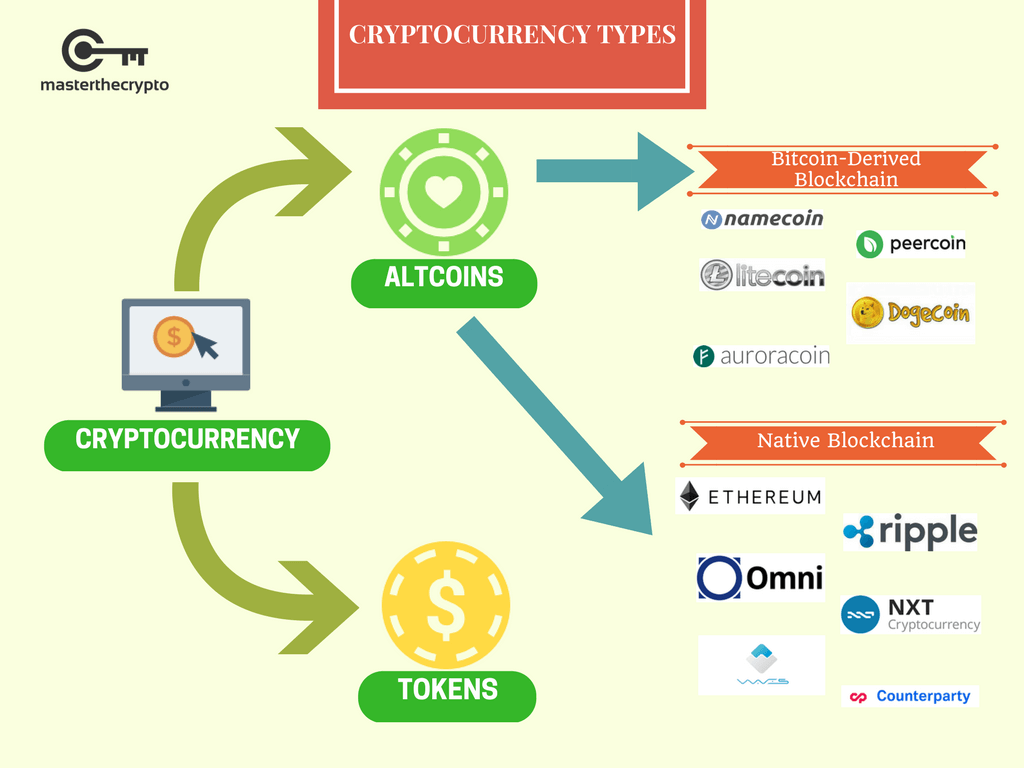
For altcoins specifically, real-world data connections matter considerably to how reliably their prices reflect genuine utility. Chainlink’s oracles enable exactly this kind of connection, feeding external information into smart contracts in ways that reduce manipulation risk and make resulting prices more trustworthy. Weather data triggering automated insurance payouts is one common example of this in practice. LINK itself powers thousands of these kinds of contracts, and its price tends to reflect that underlying utility rather than pure speculation alone. Oracle infrastructure continued expanding into AI and DeFi applications through 2025 too, a trend worth watching for continued momentum.
Pros of Using Technical Analysis in Crypto
Technical analysis genuinely improves timing for many traders, helping spot reasonable entry and exit points rather than trading purely on impulse. Its visual nature makes it accessible too — charts engage users in a way raw data tables simply don’t, and it tends to perform particularly well in volatile assets like crypto, where price swings create more frequent, clearer signals to work with.
The data backs up its popularity — roughly 89% of day traders reportedly use some form of technical analysis in their process. Beyond the practical signals it provides, it also helps build genuine trading discipline, encouraging traders to follow a defined set of rules rather than reacting purely on emotion in the moment.
Risks and Common Pitfalls
Markets can and do ignore technical patterns entirely at times — genuine black swan events happen, and no chart pattern accounts for a sudden regulatory announcement or exchange collapse. Technical analysis also overlooks news and fundamentals by design, meaning it works best as one part of a broader research process rather than a complete strategy on its own.
Over-reliance on any single indicator can lead to real losses — reportedly, only around 30% of active traders end up profitable over time, a sobering reminder that technical analysis improves odds without guaranteeing outcomes. False signals show up fairly often in crypto specifically, given how thin liquidity and high volatility can distort otherwise reliable patterns. Curve-fitting is worth avoiding too — the temptation to force past data into a pattern that “would have worked” can create a false sense of confidence that doesn’t hold up going forward.
Common Misconceptions
A common misconception holds that technical analysis predicts the future with precision. It doesn’t — it offers a statistical edge, not a guarantee. Another myth suggests it’s only useful for professional traders; in reality, beginners can learn the core concepts relatively quickly with consistent practice. Some also assume technical analysis becomes useless during bull markets specifically — that’s not accurate either, since it still helps manage risk and identify reasonable exit points even when the broader trend is favorable. Combining chart signals with broader sentiment data, including how a project is being discussed publicly, can round out the picture further.
Actionable Insights for Beginners
Starting simple by picking one indicator to learn thoroughly beats trying to master everything at once. Using demo accounts to practice without real capital at risk lets beginners build confidence before committing actual money. Watching RSI for extreme readings and generally avoiding purchases during clearly overbought conditions is a reasonable starting discipline.
Scanning candlestick charts daily and taking note of recurring patterns in assets like LINK or SOL helps build genuine pattern recognition over time. For MACD specifically, waiting for confirmation before acting on a signal — ideally alongside volume data — tends to reduce false positives. Tracking oracle-related news matters for altcoin traders too, since developments around infrastructure like Chainlink can move price meaningfully. Setting stop-losses consistently protects capital from the kind of sharp, unexpected moves crypto is known for. Joining trading communities to learn from more experienced participants rounds out a solid beginner approach.
Frequently Asked Questions
What does an RSI reading above 70 mean?
An RSI reading above 70 generally suggests an asset is overbought, meaning the price may be due for a pullback soon. It’s a probability-based signal, not a guarantee of an imminent drop.
What is a MACD crossover and what does it signal?
A MACD crossover happens when the MACD line crosses above or below the signal line. A cross above generally reads as a buy signal, while a cross below typically reads as a sell signal, reflecting a shift in underlying momentum.
Does technical analysis guarantee trading profits?
No. Technical analysis deals in probabilities, not certainties. Roughly 30% of active traders end up profitable over time, which underscores that these tools improve decision-making odds without guaranteeing any particular outcome.
Why do oracles like Chainlink matter for technical analysis on altcoins?
Oracles feed reliable real-world data into smart contracts, reducing manipulation risk and helping an asset’s price reflect genuine utility rather than pure speculation. This makes chart patterns on utility-driven tokens somewhat more meaningful than on tokens with little real-world use.
A Long-Term View
Technical analysis genuinely empowers traders by turning market chaos into something closer to structured strategy. Mastering the basics first — candlesticks, RSI, and MACD form the core toolkit — gives beginners a solid foundation to build from. Altcoins provide real, observable examples throughout, and Chainlink specifically demonstrates utility that extends well beyond pure trading signals.
Patience tends to win out over time in crypto specifically, and combining technical analysis with genuine fundamental research produces better long-term results than relying on either approach alone. Consistency, more than any single indicator, tends to separate traders who last from those who don’t.
Which indicator will you test first in your next trade?
References Used for This Article
- Changelly – Top Chart Patterns for Crypto Trading – https://changelly.com/blog/crypto-chart-patterns/
- altFINS – Essential Candlestick Patterns for Crypto Traders – https://altfins.com/knowledge-base/essential-candlestick-patterns-for-crypto-traders/
- Good Crypto – Relative Strength Index (RSI) Indicator for Crypto Trading – https://goodcrypto.app/relative-strength-index-rsi-indicator-for-crypto-trading-an-ultimate-guide-by-good-crypto/
- Investopedia – What Is MACD? – https://www.investopedia.com/terms/m/macd.asp
- Master The Crypto – Top 10 Crypto/Blockchain Infographics You Must Know – https://masterthecrypto.com/top-10-crypto-blockchain-infographics-you-must-know/
This is not financial advice. Crypto is volatile — always do your own research and only invest what you can afford to lose.