Short answer: In mid-December 2025, XRP saw five major developments land within roughly the same week — spot XRP ETFs crossed $1 billion in cumulative inflows, Ripple’s RLUSD stablecoin expanded onto Ethereum layer-2 networks, Swiss-based AMINA Bank went live with Ripple Payments as the first European client, the OCC conditionally approved Ripple’s national trust bank charter, and Ripple partnered with TJM on institutional digital asset execution. Together, these events marked a genuinely dense stretch of institutional and regulatory progress for XRP’s ecosystem.
As 2025 wound down, XRP captured attention with this cluster of pivotal advancements that highlighted its evolving position at the intersection of cryptocurrency and traditional finance. That week’s developments, from ETF milestones to regulatory approvals, signaled a genuinely maturing ecosystem even amid broader market volatility. Looking back, these updates mattered because they reflected accelerating institutional interest in XRP at a specific moment, setting the stage for wider adoption in cross-border payments and asset tokenization. In a year already marked by regulatory clarity and infrastructure growth, this particular week offered a clear snapshot of how digital assets were working their way into global financial systems.
What Is XRP? Key Concepts Explained
XRP is the native cryptocurrency of the XRP Ledger, a decentralized blockchain designed for fast, low-cost transactions. Created by Ripple Labs in 2012, XRP functions as a bridge currency for international money transfers, enabling near-instant settlements without needing intermediaries like correspondent banks. Think of it as a digital equivalent to the SWIFT system, but considerably faster and cheaper — like upgrading from postal mail to email for moving money globally.
Ripple, the company behind much of XRP’s development, focuses on enterprise solutions, including Ripple Payments, which helps banks and financial institutions handle cross-border transactions efficiently. RLUSD, Ripple’s U.S. dollar-backed stablecoin, adds stability to the ecosystem by pegging its value to the dollar, making it well-suited for payments and hedging against volatility. Unlike more volatile tokens, stablecoins like RLUSD maintain a 1:1 ratio with fiat reserves that are subject to regular auditing for transparency.
The XRP Ledger itself is an open-source protocol, supporting features like automated market makers for liquidity and smart contract functionality for more complex applications. While XRP has faced scrutiny over its association with Ripple — often misconstrued as meaning the network is centralized — the ledger actually operates independently, with validators located worldwide ensuring consensus.
Five Key Developments From That Week
This roundup covers the breakthroughs that demonstrated XRP’s momentum during that mid-December 2025 stretch. Each development built on prior progress earlier in the year, including the resolution of Ripple’s long-standing SEC lawsuit, which had already clarified XRP’s non-security status for secondary market trades.
1. XRP ETFs Surpassed $1 Billion in Cumulative Inflows
U.S. spot XRP ETFs reached a significant benchmark that week, crossing $1 billion in cumulative net inflows since their launch on November 13, 2025. This milestone was reached in under four weeks, marking one of the fastest accumulations for a new crypto ETF category since Ethereum’s own debut.

Data from SoSoValue showed consistent daily inflows, with $10.89 million added on December 15 alone, pushing the cumulative total over the $1 billion threshold. That surge reflected strong institutional demand even as XRP’s price hovered around $1.88, down 13% year-to-date despite the positive catalyst. For context, this inflow rate outpaced early Ethereum ETF performance, underscoring XRP’s appeal for diversified institutional crypto exposure at the time.
2. RLUSD Expanded to Ethereum Layer-2 Networks
Ripple announced the multi-chain expansion of its stablecoin, RLUSD, to several Ethereum layer-2 blockchains, including Optimism, Base, Ink, and Unichain. This move, facilitated by Wormhole’s Native Token Transfer standard, allowed seamless, native transfers across chains, enhancing overall interoperability for the stablecoin.
Launched in December 2024 on the XRP Ledger and Ethereum mainnet, RLUSD grew rapidly, surpassing a $1.3 billion market cap during 2025 and ranking it among the top five global stablecoins at the time. The layer-2 expansion aimed to unlock new use cases, such as pairing RLUSD with wrapped XRP for trading and liquidity on those networks, subject to final regulatory approvals. This positioned RLUSD as a compliant, enterprise-grade stablecoin for payments and DeFi use cases.
3. AMINA Bank Adopted Ripple Payments as First European Client
In a landmark moment for European banking, Swiss-based AMINA Bank became the first European institution to go live with Ripple Payments. This integration enabled 24/7, real-time cross-border settlements, connecting blockchain efficiency with traditional fiat rails.
AMINA, a regulated crypto bank, leveraged Ripple’s technology to offer clients faster, more cost-effective transfers without relying on legacy systems like SWIFT. This partnership built on Ripple’s existing network of over 300 financial institutions, emphasizing compliance and scalability. For AMINA, it meant expanded services in digital assets, potentially attracting more institutional clients across the EU.
4. The OCC Granted Conditional Approval for Ripple’s National Trust Charter
The Office of the Comptroller of the Currency conditionally approved Ripple’s application for a national trust bank charter on December 12, alongside similar approvals for Circle, Paxos, BitGo, and Fidelity Digital Assets. This federal oversight allowed Ripple to offer custody and settlement services under a unified regulatory framework.
The approval paired with Ripple’s existing New York Department of Financial Services license, creating what many in the industry called a “gold-standard” setup for stablecoin operations like RLUSD. It signaled growing federal acceptance of crypto firms operating like banks, potentially streamlining operations and boosting investor confidence broadly. For XRP specifically, this enhanced Ripple’s ability to integrate the token into regulated financial products going forward.
5. Ripple Partnered With TJM for Institutional Digital Asset Execution
Ripple expanded its reach into institutional trading by partnering with TJM, a premier execution and clearing services provider. Ripple agreed to supply infrastructure for TJM’s digital asset expansion, combining Ripple Prime’s capabilities with TJM’s expertise in serving hedge funds, family offices, and asset managers.
This collaboration aimed to improve capital efficiency in global markets, allowing faster access to liquidity for institutional clients. It built on Ripple’s long-standing relationship with TJM, further embedding XRP-related tools into traditional finance workflows.
What This Cluster of News Meant for the Broader Trend
These developments aligned with broader trends underway across fintech, where digital assets were increasingly integrated into mainstream financial systems. Institutional adoption, as seen in ETF inflows and bank partnerships, was driving XRP’s utility case beyond pure speculation. RLUSD’s growth, for instance, mirrored the broader stablecoin market’s expansion, which some analysts projected could reach $3 trillion by 2028. In real-world terms, these kinds of advancements had the potential to reduce cross-border payment costs by up to 70%, which would meaningfully benefit remittance-heavy economies like those across Southeast Asia.
Pros, Risks, and Common Misconceptions
XRP’s strengths have consistently lain in its speed — transactions settle in seconds — and its low fees, making it well-suited for high-volume payment use cases. Partnerships with banks like AMINA enhanced credibility, while ETF products provided more accessible exposure for retail investors who wanted institutional-grade access.
Risks remained alongside those strengths, though, including price volatility — XRP was down roughly 8-13% year-to-date at various points in 2025 despite these positive catalysts. Regulatory shifts, such as potential changes in policy outside the U.S., could still impact operations going forward. A common misconception worth addressing directly: many assume XRP is fully controlled by Ripple. In reality, the XRP Ledger is decentralized, with Ripple holding a significant but non-controlling stake in the token supply.
Another persistent myth suggests XRP is only useful for banks. While enterprise use is genuinely central to its case, its growing role in DeFi and NFTs on the XRP Ledger shows broader potential beyond institutional payments alone.
Frequently Asked Questions
What is RLUSD?
RLUSD is Ripple’s U.S. dollar-backed stablecoin, launched in December 2024 on the XRP Ledger and Ethereum mainnet. It maintains a 1:1 peg with dollar reserves and grew to a $1.3 billion market cap during 2025, ranking among the top five global stablecoins at the time.
Does Ripple control the XRP Ledger?
No. This is a common misconception. The XRP Ledger is decentralized, with independent validators worldwide maintaining consensus. Ripple holds a significant stake in XRP tokens but does not control the network itself.
What did the OCC’s conditional approval mean for Ripple?
The OCC’s conditional approval of Ripple’s national trust bank charter in December 2025 allowed the company to offer custody and settlement services under a unified federal regulatory framework, alongside similar approvals granted to Circle, Paxos, BitGo, and Fidelity Digital Assets.
How quickly did XRP ETFs reach $1 billion in inflows?
U.S. spot XRP ETFs crossed $1 billion in cumulative net inflows in under four weeks following their November 13, 2025 launch — one of the fastest accumulations for a new crypto ETF category on record at the time.
Looking Back on the 2026 Outlook
At the time, some analysts were bullish on XRP’s trajectory heading into 2026. Standard Chartered, for instance, had forecast a price target around $8 by year-end, driven by expectations of increased adoption in payments and potential market share gains from traditional cross-border systems. That optimism stemmed from the ongoing partnerships, ETF maturation, and RLUSD’s expanding role in tokenizing real-world assets described above.
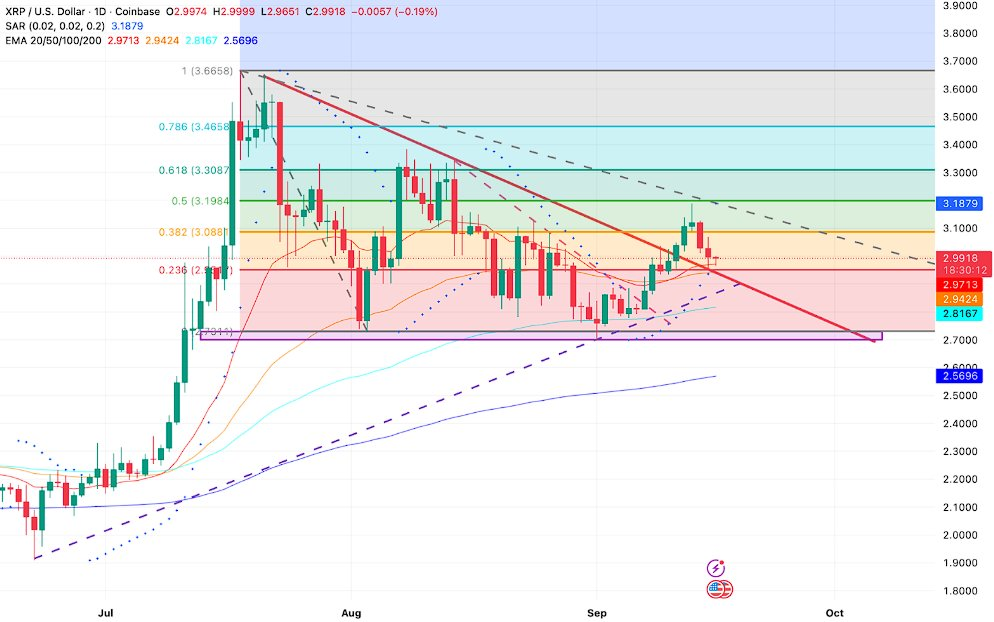
Price forecasts like these are, by their nature, speculative and shouldn’t be treated as guarantees — they reflect one analyst’s read on the data available at the time, not a certainty. What’s clear regardless is that XRP’s underlying utility case, built on real ETF adoption, banking partnerships, and regulatory clarity, gave it a stronger fundamental footing heading into 2026 than it had in prior years.
As XRP continued bridging traditional and digital finance through late 2025, the developments covered here offered a useful marker of just how far that integration had progressed by that point.
This is not financial advice. Crypto is volatile — always do your own research and only invest what you can afford to lose.