
Short answer: Solana and XRP have carved out genuinely different niches rather than competing head-to-head. Solana’s DeFi ecosystem grew its total value locked to roughly $8.5 billion in 2025 on the strength of high-speed, low-cost transaction throughput, while XRP built out its role as a cross-border payment bridge currency, settling transactions in 3-5 seconds following regulatory clarity from Ripple’s SEC settlement. Investors comparing the two are really comparing two different bets: innovative DeFi infrastructure versus efficient payment rails.

As the cryptocurrency landscape moved through 2025 and into 2026, two prominent players — Solana and XRP — continued carving out these distinct niches rather than converging into a single lane. Solana surged in decentralized finance, attracting developers and users with its high-speed blockchain architecture. XRP, meanwhile, maintained its focus on cross-border payments, leveraging newfound regulatory clarity to expand institutional adoption steadily. This comparison mattered because both ecosystems sat at genuine inflection points — Solana’s DeFi total value locked had grown substantially, while XRP’s real-world payment utility stood to benefit from a broader global shift toward faster cross-border settlement.
Understanding these dynamics helps investors navigate a market where hype often overshadows underlying fundamentals. With Bitcoin’s dominance in altcoin narratives gradually loosening its grip, Solana and XRP represent genuinely contrasting paths — one built around innovative finance, the other around efficient transaction settlement.
Understanding Solana and XRP in Plain Terms
Solana is a blockchain platform built specifically for speed and scalability — often compared to a superhighway for digital applications. It uses a unique proof-of-history consensus mechanism, which allows for thousands of transactions per second without the bottlenecks that plague older networks like early Ethereum.
XRP, on the other hand, is the native token of the XRP Ledger, created originally by Ripple Labs. Think of it as a bridge currency for international money transfers — converting dollars to euros nearly instantly and cheaply, bypassing the delays baked into traditional banking rails.
While Solana powers DeFi applications like lending platforms and decentralized exchanges, XRP excels specifically at payment utility, settling transactions in seconds for fractions of a penny.
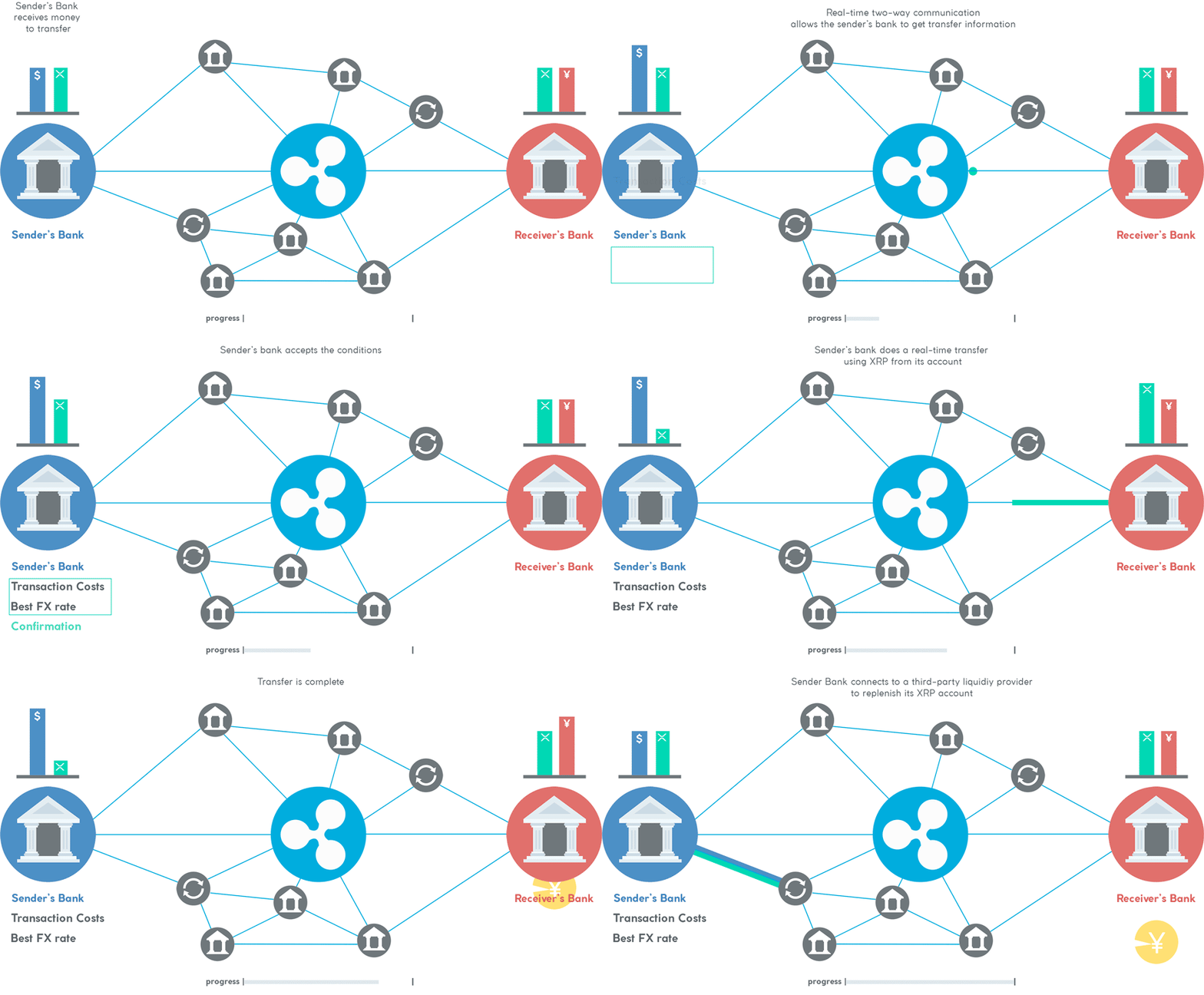
This comparison illustrates XRP’s role within Ripple’s broader payment network, highlighting how it facilitates seamless cross-border value flows compared to legacy systems like SWIFT.
Trends and Real-World Relevance
Through 2025, Solana’s DeFi ecosystem experienced robust growth, with its total value locked reaching approximately $8.5 billion — ranking second only to Ethereum among DeFi chains. This surge reflected increased developer activity and deeper integrations, particularly with stablecoins like USDC, which came to dominate on-chain trading volume. Continued network upgrades and growing institutional interest have kept that growth trajectory intact heading into 2026.
XRP’s payment utility advanced considerably over the same period. The XRP Ledger processed over 3.8 billion transactions since its inception, representing more than $1.5 trillion in cumulative value moved. In 2025, XRP achieved meaningful regulatory clarity following Ripple’s SEC settlement, which helped push its market cap toward roughly $120 billion and positioned it among the largest cryptocurrencies by that measure. Adoption trends pointed toward expanded use in banking specifically, with partnerships across Asia and growing interest in tokenized real-world assets adding to XRP’s utility case.
Comparatively, Solana’s DeFi focus outpaced XRP on pure innovation velocity, but XRP’s enterprise integrations offered a different kind of value: stability and institutional trust amid broader market volatility.
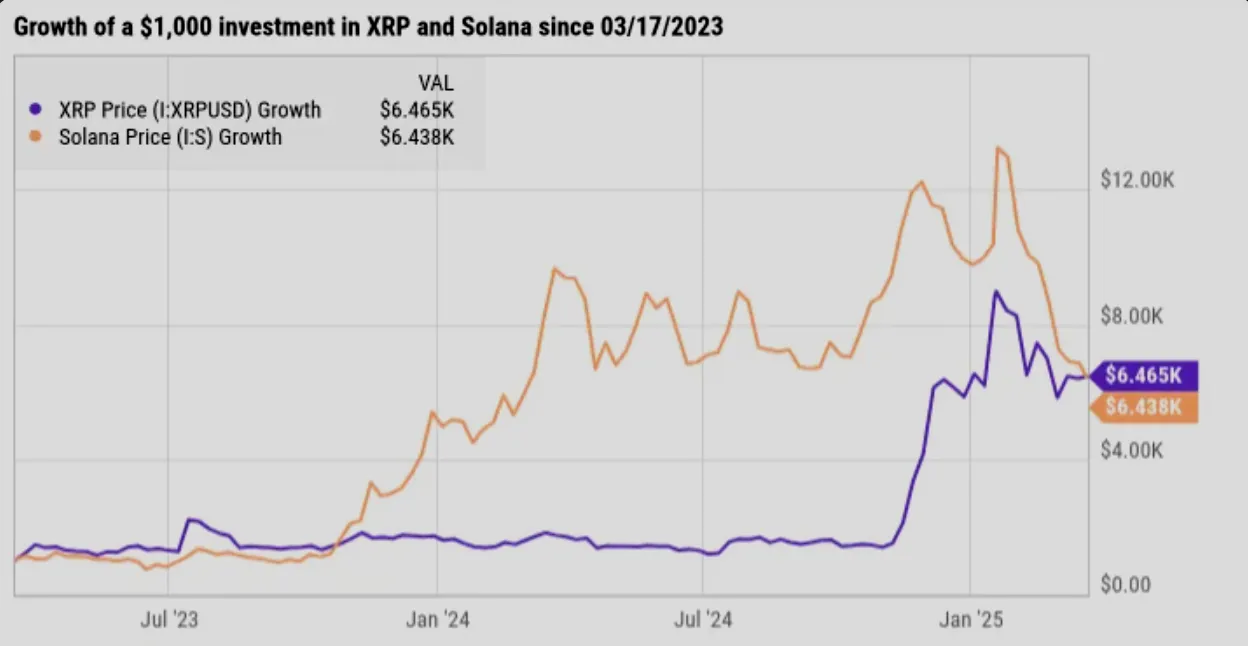
Pros, Risks, and Common Misconceptions
Solana’s advantages include blistering transaction speeds — up to 65,000 per second under optimal conditions — and low fees, making it well-suited for DeFi applications like yield farming or NFT trading. Its 2025 growth, including a substantial TVL surge, underscores that appeal clearly. Real risks persist too, though: past network outages have raised legitimate reliability concerns, even as upgrades like Firedancer have worked to address those weaknesses over time.
XRP shines specifically in payment efficiency, with settlements completing in 3-5 seconds at near-zero cost — far superior to SWIFT’s multi-day processing times for comparable cross-border transfers. Its institutional backing from banks provides a genuine competitive moat, though reliance on Ripple’s broader ecosystem does expose it to some centralization-adjacent risk, even with the ledger itself operating in a decentralized manner.
One common misconception frames Solana as an “Ethereum killer” purely on the basis of speed — it’s more accurate to think of it as a complementary chain built for high-throughput applications rather than a direct replacement. For XRP, many investors still assume it’s simply a “bank coin,” which overlooks its decentralized exchange functionality and growing DeFi integrations. Both assets carry their own market risks: Solana’s volatility ties partly to broader meme coin trends, while XRP remains sensitive to regulatory shifts even after achieving greater clarity.
Actionable Insights for Investors
For those evaluating Solana, monitoring DeFi metrics like total value locked on platforms such as DefiLlama offers a useful, unbiased gauge of real activity. Staking SOL for yield, or exploring lending protocols for diversified exposure, are both common approaches worth researching independently. Watching for cross-chain expansion and real-world asset tokenization developments can help identify where genuine growth is likely to concentrate next.
With XRP, focusing on payment adoption signals — new Ripple partnerships or institutional inflows, for instance — tends to matter more than short-term price swings. Holding for long-term utility exposure while diversifying to hedge against volatility makes sense for most investors rather than concentrating heavily in a single asset. Tracking on-ledger metrics like transaction volume can also help distinguish organic growth from speculative noise.
In both cases, prioritizing wallets with strong security practices and using hardware devices for larger holdings remains sound practice regardless of which asset you’re holding. Staying informed through primary sources like CoinGecko or official project reports, and avoiding excessive leverage in volatile markets, applies universally here.
Frequently Asked Questions
What consensus mechanism does Solana use?
Solana uses proof-of-history, a unique consensus mechanism that timestamps transactions before they’re confirmed, allowing the network to process thousands of transactions per second without the bottlenecks common to older blockchain architectures.
How fast do XRP transactions settle?
XRP transactions typically settle in 3-5 seconds at a cost of fractions of a penny, compared to traditional cross-border banking systems like SWIFT, which can take multiple days to complete a transfer.
Is Solana an “Ethereum killer”?
Not exactly. While Solana offers faster and cheaper transactions in many cases, it’s more accurate to view it as a complementary chain optimized for high-throughput applications rather than a direct one-to-one replacement for Ethereum’s ecosystem.
Is XRP just a “bank coin”?
No, this is a common oversimplification. While XRP does have strong institutional banking partnerships, the XRP Ledger also supports a decentralized exchange and growing DeFi integrations beyond pure payment settlement use cases.
A Long-Term Perspective on Solana and XRP
Solana’s DeFi dominance and XRP’s payment prowess together highlight blockchain’s maturation beyond pure speculation. Solana appeared positioned to lead in innovative finance applications, while XRP looked positioned to solidify its role within the massive global cross-border payments industry.
Success for both ultimately hinges on continued execution: Solana needs sustained network uptime and reliability, while XRP requires broader real-world adoption beyond its existing banking partnerships. Together, they illustrate how specialized utility, rather than generalized hype, tends to drive lasting value across the crypto market.
Will Solana’s speed advantage in DeFi ultimately outpace XRP’s efficiency in payments, or will hybrid approaches eventually merge both of their strengths?
References Used for This Article
- DefiLlama – Chains Overview – https://defillama.com/chains
- Ripple – Official XRP Page – https://www.ripple.com/xrp/
- FXStreet – Ripple Price Annual Forecast – https://www.fxstreet.com/cryptocurrencies/news/ripple-price-annual-forecast-xrp-eyes-record-high-breakout-in-2026-as-ripple-scales-infrastructure-202512171156
- AInvest – Solana Price Momentum Report – https://www.ainvest.com/news/solana-price-momentum-market-optimism-network-growth-fuel-50-rally-early-2026-2512/
This is not financial advice. Crypto is volatile — always do your own research and only invest what you can afford to lose.
[…] While not as headline-grabbing as the GENIUS Act, bipartisan discussions in Congress pushed for clearer tax treatment of staking rewards—earnings from validating blockchain transactions. Although full exemptions didn’t materialize, proposed reforms sought to defer taxes on staking until rewards are sold, treating them like unrealized gains in traditional investments. This reflects ongoing efforts to adapt crypto tax laws 2025 to innovative activities, reducing the burden on participants in decentralized finance (DeFi). […]