As cryptocurrency markets surge—with Bitcoin’s market capitalization hitting $1.83 trillion and trading volumes exceeding $38 billion daily—navigating cryptocurrency taxation basics becomes essential for investors in 2026.

Cryptocurrency Taxation Basics: What You Need to Know in 2026 (Country-Specific Guides)
Short answer: yes, most crypto activity is taxable, and the rules are getting stricter in 2026. Selling, trading, spending, staking, and mining are all taxable events in the US, UK, EU, and Canada — simply holding isn’t. Bitcoin’s market cap is sitting near $1.83 trillion, with daily volumes topping $38 billion, and every government watching that growth wants its share. This guide breaks down exactly what triggers a tax bill, how the rules differ by country, and what you actually need to do about it.
Why Cryptocurrency Taxation Matters in 2026
Cryptocurrencies have evolved from niche experiments to mainstream assets. Yet with growth comes scrutiny. Governments worldwide are closing loopholes to capture revenue from this booming sector. The IRS in the US collected over $38 billion in crypto-related taxes in 2024, a 45% increase from 2023 — a clear sign that tax authorities are ramping up enforcement, helped along by blockchain analytics tools that make hiding transactions much harder than it used to be.
In 2026, new reporting requirements kick in. Think of it like stock trading: every transaction could trigger a tax event. Ignoring this risks audits, penalties, or even asset seizures, as seen in recent South Korean rulings. For serious investors, mastering these rules isn’t optional — it’s a strategic edge in a volatile market.

Breaking Down Cryptocurrency Taxation Basics
At its core, cryptocurrency taxation treats digital assets like property, not currency. That means taxes apply when you realize gains or income. Imagine buying a house: you pay tax only when you sell it for profit. Crypto works the same way.
Taxable Events Explained
Several actions trigger taxes. Selling crypto for fiat currency? That’s a capital gain if the value rose. Trading one coin for another, like Bitcoin for Ethereum? Taxable, since it counts as disposing of property. Earning from mining or staking? That’s ordinary income, taxed at your regular rate.
In plain terms, if you use crypto to buy goods — like paying for coffee with Bitcoin — you’ve triggered a taxable event based on the coin’s appreciation since you acquired it. Even airdrops or forks can count as income. However, simply holding or transferring crypto between your own wallets usually isn’t taxed.
Cost Basis and Gains Calculation
Your cost basis is what you paid for the crypto, including fees. Subtract this from the sale price to find your gain. Short-term holdings (under a year) often face higher taxes; long-term ones get preferential rates. Tax software automates the math, but accuracy still starts with good records.

Country-Specific Guides to Cryptocurrency Taxation Basics
Rules vary by jurisdiction. Here’s a breakdown for key regions, focusing on 2026 updates.
United States: IRS Rules Tighten
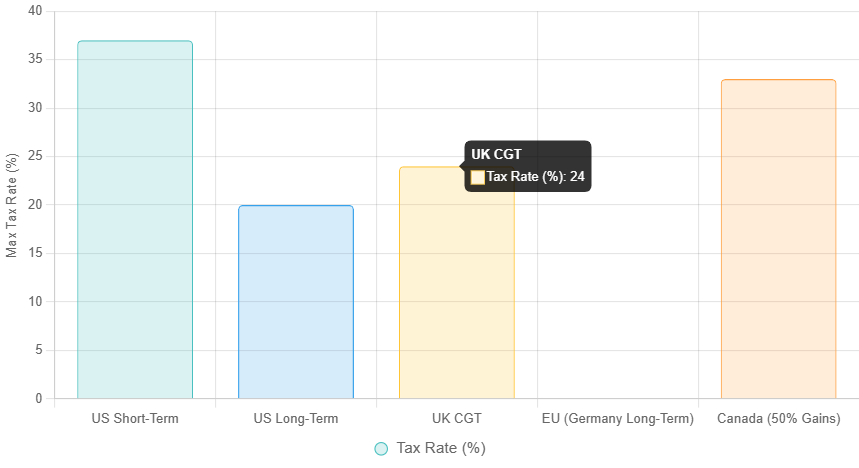
In the US, the IRS views crypto as property. Starting 2026, brokers report cost basis on Form 1099-DA, alongside gross proceeds. Capital gains rates run 0-20% for long-term holdings, up to 37% for short-term.
There’s no de minimis threshold — all transactions count, regardless of size. Mining income is taxed at receipt, then gains are taxed again on sale. Wallet-by-wallet accounting adds complexity, but software helps.
European Union: DAC8 Takes Effect
The EU’s DAC8 directive mandates reporting from January 2026. Crypto-asset service providers will share user data across member states by 2027. Taxation still varies by country: Germany offers 0% on holdings over a year, while Spain hits large gains with rates up to 30%.
Stablecoins and NFTs fall under the same scrutiny. There’s no uniform EU rate — check local rules, like France’s progressive income tax that tops out at 45%.
United Kingdom: HMRC’s Reporting Framework
The UK taxes crypto as property under capital gains (18-24% in 2026) or as income (up to 45%). From January 2026, CARF requires exchanges to report transactions. There’s a £3,000 tax-free allowance annually.
DeFi lending may defer taxes under proposed “no gain, no loss” rules. Voluntary disclosure is available for past gains you haven’t reported yet.
Canada: CRA’s Commodity Approach
Canada treats crypto as a commodity. 50% of capital gains are taxable at federal rates (15-33%) plus provincial tax. If your trading looks business-like, it’s fully taxable as income instead.
2026 brings enhanced reporting, with deadlines falling April 30 for most filers. Losses can offset gains, but only 50% of a loss is deductible.
Current Trends in Cryptocurrency Taxation
2026 marks a pivot toward transparency. Global frameworks like CARF and DAC8 now enable data sharing among 75+ countries. In the EU, stablecoins make up roughly 90% of crypto market cap, which is prompting stricter oversight.
US crypto activity surged 50% in early 2025, boosting tax revenue along with it. Watch for DeFi taxation next — yield farming treated as income — and NFT-specific rules, where creation itself might count as business income.
Fintech integrations, like Chainlink’s oracles feeding real-world data into smart contracts, could eventually streamline automated tax reporting altogether.
Pros, Risks, and Common Misconceptions
Clear rules foster trust, which tends to encourage institutional adoption rather than scare it off. There are real upsides too — losses can often be deducted, offsetting other income.
The risks are real, though. Noncompliance can mean penalties of up to 75% of unpaid tax in the US. Volatility cuts both ways — it amplifies gains, but also losses if you don’t harvest them strategically.
One common misconception: “crypto isn’t taxed until you cash out.” That’s wrong — trades count too. Another: “offshore wallets hide assets.” With global reporting frameworks now in place, evasion is a lot riskier than it used to be. Some studies put noncompliance rates above 90% in certain regions, which underscores just how widespread the confusion still is.
Actionable Insights for Investors
Track everything. Tools like Koinly (800+ integrations, from $49/year) or CoinTracker generate automated reports that make filing far less painful. Consider tax-loss harvesting too — selling losing positions to offset gains elsewhere in your portfolio.
Watch for updates — the US GENIUS Act could reshape how stablecoins are treated. And talk to a tax professional; this is general information, not personalized advice.
Do maintain records, and report accurately by your deadline (US filers: April 15, 2026). Think long-term where you can — holding over a year usually means a lower tax rate.

Frequently Asked Questions
Do I owe tax on crypto if I never sell it?
No. Buying and holding crypto isn’t a taxable event on its own. Tax applies when you dispose of it — by selling, trading it for another asset, or spending it.
Is moving crypto between my own wallets taxable?
Generally, no. Transferring assets between wallets you own and control isn’t treated as a disposal, so it doesn’t trigger a tax event in most jurisdictions covered here.
Are staking and mining rewards taxed differently from trading gains?
Yes. Staking and mining rewards are typically taxed as ordinary income at the time you receive them. If you later sell those coins at a higher price, you’ll also owe capital gains tax on that additional appreciation.
What’s the crypto tax filing deadline in the US for 2026?
April 15, 2026, for most individual filers, the same deadline as standard federal income tax returns.
Do I need to report crypto transactions if the profit was small?
In the US, yes — there’s no de minimis threshold, so even small transactions must be reported regardless of size. Rules on minimum reporting thresholds vary elsewhere, so check the specific country guide above.
Embracing a Long-Term Perspective
Cryptocurrency taxation is evolving alongside the market itself, and if anything, that’s pushing the space toward more stability and less pure speculation. As adoption grows — stablecoins alone now sit around a $300 billion market cap — expect the rules to keep getting refined, balancing innovation against revenue collection. Investors who adapt early tend to come out ahead, treating taxes as just another part of mature asset management rather than an afterthought.
How will evolving tax policy shape the way you manage your own crypto holdings?
Top Ten References
- Digital assets | Internal Revenue Service – https://www.irs.gov/filing/digital-assets
- A Beginner’s Guide to New U.S. Crypto Tax Rules – Coinbase – https://www.coinbase.com/learn/crypto-taxes/whats-new-crypto-tax-regulation
- Your Crypto Tax Guide – TurboTax – Intuit – https://turbotax.intuit.com/tax-tips/investments-and-taxes/your-cryptocurrency-tax-guide/L4k3xiFjB
- Crypto Taxes: Expert Guide 2026 – Koinly – https://koinly.io/guides/crypto-taxes/
- New IRS Policies Raise the Stakes for Crypto Taxation – Sikich – https://www.sikich.com/insight/new-irs-policies-raise-the-stakes-for-crypto-taxation/
- European Commission – DAC8 – Taxation and Customs Union – https://taxation-customs.ec.europa.eu/taxation/tax-transparency-cooperation/administrative-co-operation-and-mutual-assistance/directive-administrative-cooperation-dac/dac8_en
- Crypto Tax UK: Expert Guide to HMRC Rules 2026 | Koinly – https://koinly.io/guides/hmrc-cryptocurrency-tax-guide/
- Crypto Tax Canada Guide: Here’s How Much You’ll Pay in 2026 | Koinly – https://koinly.io/guides/crypto-tax-canada/
- Compare Crypto Tax Tools | Expert Guide 2026 – Koinly – https://koinly.io/blog/compare-crypto-tax-software/
- Global Crypto Tax Report 2025 – Coincub – https://coincub.com/ranking/global-crypto-tax-report-2025/
This is not financial or tax advice. Crypto tax rules vary by jurisdiction and change frequently — always confirm your obligations with a qualified tax professional before filing.