Short answer: Heading into the end of 2025, XRP traded around $1.88-$1.90, down 13% year-to-date, even as spot XRP ETFs pulled in 32 straight days of inflows and exchange balances fell 45% in under 60 days — a classic tightening-supply signal. Technical levels pointed to $1.88 as critical support, with a break lower risking a slide toward $1.80 or $1.64, while reclaiming $2.00 opened the door toward $2.10 and beyond. The setup illustrated a genuine tug-of-war between bullish on-chain fundamentals and bearish short-term price action.

Navigating XRP’s Volatile Path Into Year-End
As 2025 approached its end, XRP found itself at a genuine crossroads. Forecasts at the time painted a mixed picture: AI-driven models projected a conservative $2.02 by early December, while some crypto analysts eyed a more bullish $2.85. That divergence highlighted the real uncertainty gripping the market, with XRP trading around $1.90 amid a broader crypto pullback. The moment mattered because spot XRP ETFs had surpassed $1 billion in assets under management and were showing zero outflow days since their mid-November launch, meaning institutional interest was genuinely surging. Yet price hadn’t followed that momentum, sitting down 13% year-to-date despite meaningful regulatory wins for Ripple over the preceding months. For investors treating digital assets as a hedge against traditional finance volatility, understanding this specific tension between fundamentals and price action offered a useful case study in how markets don’t always move in sync with the underlying data.
Understanding XRP: The Basics
XRP is the native cryptocurrency of the XRP Ledger, a decentralized blockchain designed specifically for fast, low-cost cross-border payments. Think of it like a digital bridge connecting different currencies — similar to how SWIFT operates for banks, but without the intermediaries and multi-day delays that come with legacy systems.
Unlike Bitcoin, which focuses on being a store of value, XRP emphasizes utility above all else. It isn’t mined; instead, all 100 billion tokens were created at launch, with a large portion held in escrow by Ripple to prevent flooding the market all at once. This structure aims for a degree of stability, though it also ties XRP’s fate somewhat to Ripple’s own partnerships and regulatory standing. For beginners, it can help to picture XRP as the fuel in a global money-transfer engine — genuinely efficient, but still dependent on the roads, meaning regulations, staying clear.
What Was Driving XRP That December
XRP’s price sat under real pressure that stretch, sliding to around $1.88 by mid-December, reflecting a 5% weekly and 18.3% monthly decline. Despite that weakness, on-chain metrics told a more optimistic story underneath. Exchange balances plummeted 45% in under 60 days, from 3.95 billion to 1.6 billion tokens, signaling reduced selling pressure as holders moved assets off exchanges into private wallets. This kind of tightening supply has historically preceded rallies in other assets too, including Bitcoin during past accumulation phases.
Institutional adoption stood out as another genuine bright spot. XRP ETFs saw 32 straight days of inflows at that point, reaching $1.14 billion in assets under management and $30.41 million in net inflows on December 18 alone. Derivatives markets showed thinned speculative interest at the same time, though, with leveraged trade ratios sitting at their lowest since November 2024 — suggesting the rally, if it came, would need to be driven by genuine spot demand rather than leveraged bets. Real-world relevance kept building through Ripple’s integrations, including work related to stablecoin settlement infrastructure that could indirectly support XRP’s broader ecosystem role.
On the XRP Ledger itself, activity remained genuinely robust: average daily transactions hit 1.8 million in Q3 2025, with velocity spiking to 0.0324 on December 2 — a near-record high for the network. These underlying trends suggested real strength beneath the surface, even as broader market sentiment continued weighing on price at the time.
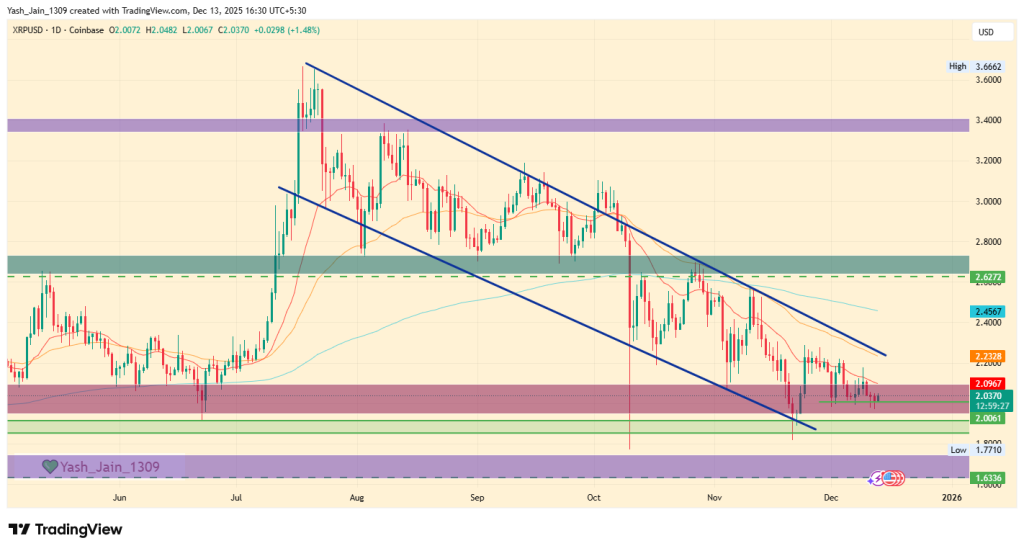
Technical Levels That Mattered
From a technical standpoint, XRP’s charts showed a bearish tilt in the short term at that stage. The Relative Strength Index hovered around 33 on daily timeframes, indicating oversold conditions while still trending lower — a combination that could signal a potential rebound if buyers stepped in, not unlike a coiled spring building tension before release.
Support proved critical at $1.88, aligning with the 0.5 Fibonacci retracement level from recent highs. A break below that threshold risked a push toward $1.80 or even $1.64, the 0.618 Fibonacci level. Conversely, reclaiming $2.00 as a support level could have opened the door toward $2.10 or higher. The 50-day moving average was declining at the time, underscoring short-term weakness, while the 200-day average had also turned down since mid-December.
Macro factors added extra complexity: ETF inflows hadn’t yet translated into a corresponding price pump, possibly because traders were taking profits from concurrent Bitcoin rallies instead. Still, with Korean exchanges like Upbit showing whale withdrawals for the first time since 2023, a genuine accumulation pattern appeared to be forming beneath the price weakness.
Pros, Risks, and Common Misconceptions
XRP’s strengths rested squarely on its real-world utility. Partnerships with banks and fintech firms positioned it as a genuine contender in cross-border payments, with room to capture a meaningful slice of the massive global remittance market over time. Its lightning-fast transaction speeds — under 5 seconds — and minimal fees made it attractive for institutions specifically wary of Bitcoin’s price volatility.
Real risks remained equally pronounced, though. Regulatory overhang persisted even after Ripple’s SEC settlement, with potential appeals or fresh scrutiny always a possibility. Market correlation with Bitcoin meant XRP often suffered during broader downturns regardless of its own fundamentals. A couple of misconceptions deserve direct addressing: XRP isn’t fully controlled by Ripple — while Ripple does hold a significant escrow position, the ledger itself operates in a decentralized manner, with community governance playing a real role. Another persistent myth frames XRP purely as a “banker coin,” which ignores its open-source, permissionless nature that’s accessible to anyone, not just financial institutions.
Actionable Insights for Investors
For readers evaluating similar setups, focusing on a handful of key indicators tends to cut through market noise more effectively than headline-chasing. Monitoring ETF flows via reputable sources offers a read on institutional conviction, since accelerating inflows have historically preceded price rebounds. Tracking on-chain data through platforms built for that purpose can reveal further supply squeezes worth watching. On the technical side, an RSI divergence moving back above 40 has often served as a useful buy signal, as has a clean bounce off established support levels.
Considering diversification within digital assets makes sense too — pairing XRP exposure with stablecoins can offer payments-sector exposure without taking on the full brunt of price volatility. Long-term holders have often viewed dips like this one as entry points, though price forecasts from various sources during this period ranged widely, from conservative year-end estimates near $1.88 to considerably more bullish targets above $5 if key resistance broke decisively. It’s worth treating the most extreme predictions with real skepticism — social media sentiment during volatile stretches tends to amplify outlier forecasts that rarely hold up against actual price history.
Frequently Asked Questions
Why did falling XRP exchange balances matter?
Exchange balances fell 45% in under 60 days at the time, from 3.95 billion to 1.6 billion tokens. When holders move tokens off exchanges into private wallets, it typically signals reduced intent to sell in the near term, which can tighten available supply and support prices.
What was XRP’s key support level at the time?
$1.88 served as critical support, aligning with the 0.5 Fibonacci retracement level from recent highs. A break below risked a decline toward $1.80 or the 0.618 Fibonacci level near $1.64.
Does Ripple fully control XRP?
No. While Ripple holds a significant portion of XRP in escrow, the XRP Ledger itself operates in a decentralized manner, with independent validators and community governance playing a genuine role in the network.
Is XRP only useful for banks?
No, this is a common oversimplification. XRP is open-source and permissionless, meaning anyone can use the XRP Ledger, not just financial institutions, even though banking partnerships form a central part of its utility case.
A Cautious Outlook at the Time
In summary, XRP’s path through the end of 2025 balanced on ETF-driven inflows and on-chain resilience against real technical headwinds. A cautious rebound toward the $2.50 range seemed plausible at the time if macro conditions aligned favorably, but a drop toward $1.80 remained a genuine risk if support cracked. Longer-term, XRP’s utility case in fintech looked positioned to drive more sustained growth than assets relying primarily on hype cycles.
Did XRP’s real-world adoption ultimately propel it beyond that short-term volatility, or did broader market forces keep it anchored regardless? That’s worth checking against the actual price history that followed rather than speculating further here.
This is not financial advice. Crypto is volatile — always do your own research and only invest what you can afford to lose.